
Ursula: Issue 19
Estimated shipping date – late September
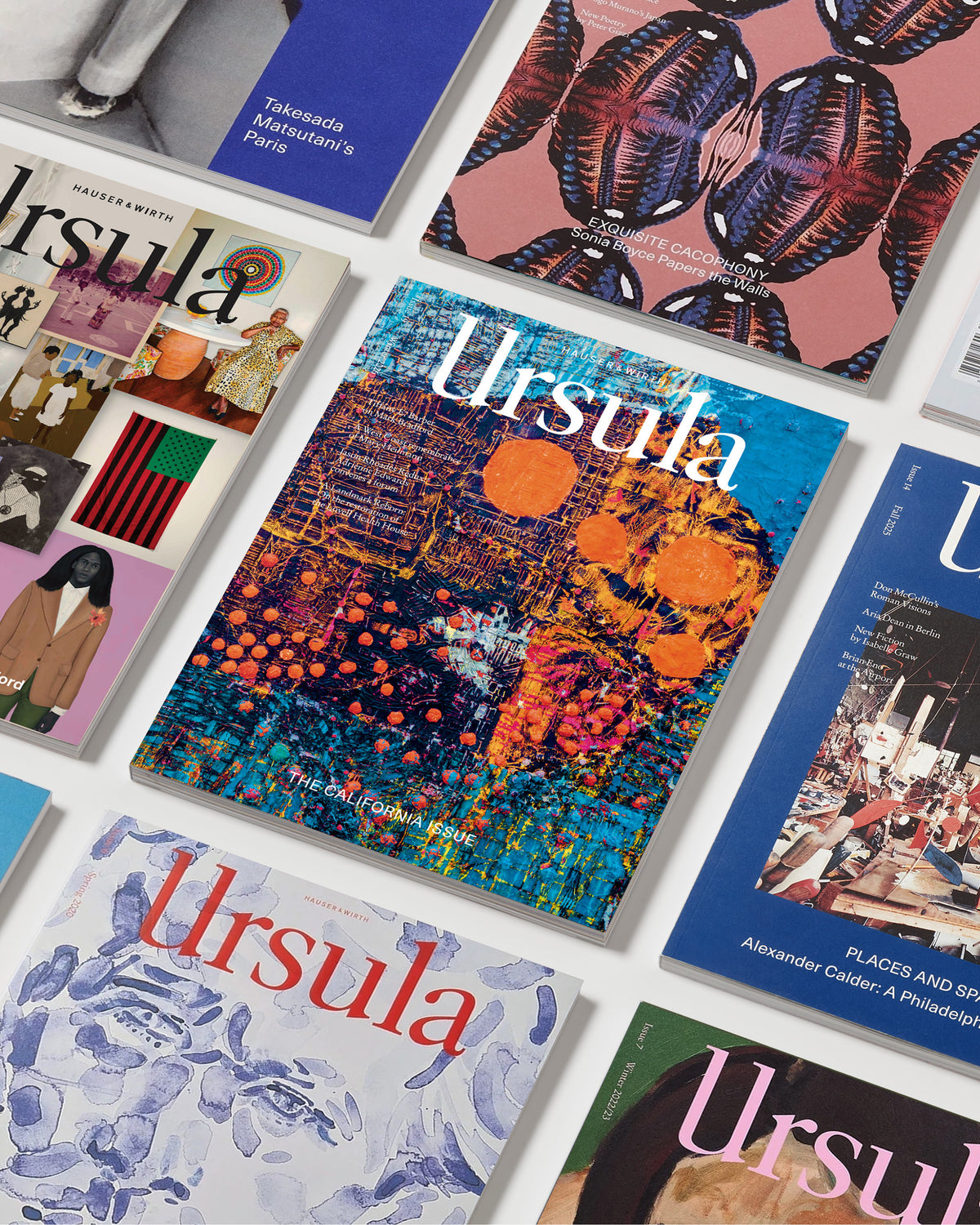
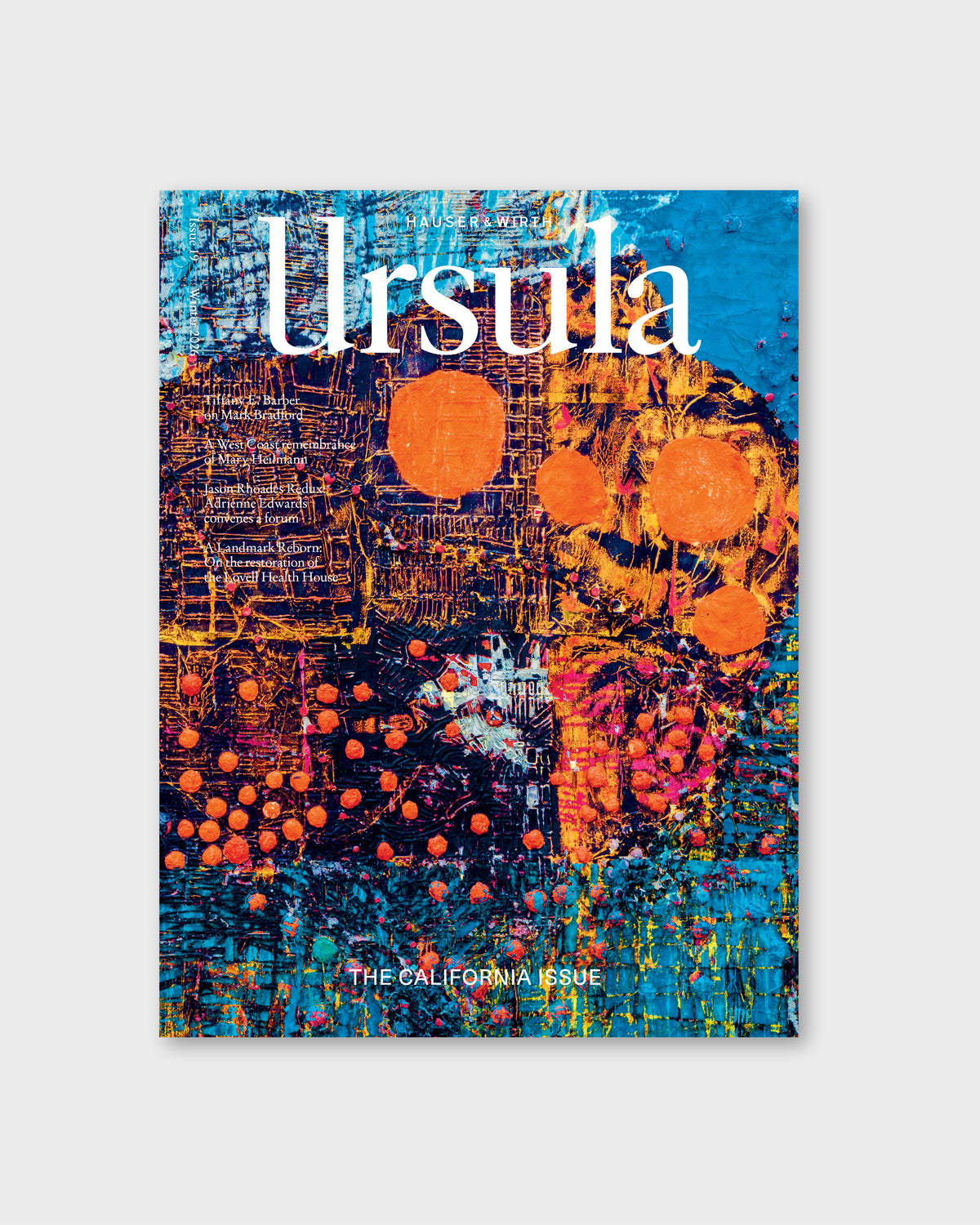
Ursula 19 celebrates the state of California, a fertile ground for generations of influential artists throughout the 20th and 21st centuries. California is foundational to Hauser & Wirth, which this year celebrates the tenth anniversary of its home in Downtown Los Angeles and the opening of a new space in Palo Alto.
In the cover story, Tiffany E. Barber reads the Los Angeles histories embedded in Mark Bradford’s monumental ‘Deep Blue’ (2018), examining how the artist transforms the language of abstraction into a material record of social life.
Also in this issue, Editor in Chief Randy Kennedy writes a remembrance of California-born artist Mary Heilmann, discussing her West Coast roots, influences and motivations. A new iteration of ‘The Art That Made Me’ brings together Lee Bul and Ekow Eshun to explore the influences that have shaped the artist’s life and work. Adrienne Edwards convenes artists and writers Aria Dean, Ellen Gallagher, Zakiyyah Iman Jackson and Simone White to take a new look at Jason Rhoades’s provocative ‘Black Pussy’. Mimi Zeiger presents an oral history of the restoration of Richard Neutra’s Lovell Health House, and on the final page of the issue collector and patron Ursula Hauser revisits her early memories of California.
Shipping & Returns
Depending on your location, items that you order may be shipped from the US or Europe.
We aim to deliver all orders within the UK / EU / US within 5 working days. Orders to be delivered to other destinations can normally be expected to arrive within 7 – 10 working days.
Shipping charges for all destinations will be calculated at checkout and included on your Order Confirmation.
For more information please review our Shipping & Returns Policy.
Choose options

Language
English
size
30.5 x 23 cm
Pages
128
Publication date
December 2026
From the Editor
The novelist Edward Abbey once wrote that “there is science, logic, reason; there is thought verified by experience. And then there is California.” While the statement implies a knock, one that echoes every tired critique ever uttered by a non-Californian, the flip side is the recognition of freedom, experimentation, revelation and ground-up reinvention that have shaped the state’s identity.
The issue of Ursula you hold in your hands is a very special one for us, devoted to California, breeding ground and new arcadia for so many great artists over the 20th and 21st centuries. The state is foundational for Hauser & Wirth, which this year celebrates the tenth anniversary of its home in Downtown Los Angeles and the opening of a new space in Palo Alto, as well as an outpost in West Hollywood inaugurated in 2023, all places where the gallery’s long-term relationships with so many artists have been nurtured.
To understand California, the great architectural historian and transplanted Angeleno Reyner Banham once quipped that he taught himself to drive so that he could read the state “in the original,” much the way intellectuals of previous centuries taught themselves Italian in order to deepen their understanding of Dante.
At the risk of blatant cliché, I’d venture to guess that, over more than twenty years of visiting California artists and writing about them, at least half of my West Coast education in art has likewise taken place inside cars.
It was in Paul McCarthy’s Subaru hatchback as he shuttled between his far-flung studios in 2012 and 2013 that I first learned about so many of the underrecognized Los Angeles and Bay Area artists who were important to him, among them Wally Hedrick, Robert Mallary, Paul Cotton, Al Payne and Barbara T. Smith.
It was in Ubers with Mary Heilmann, on our way around downtown and out to Venice to see Larry Bell, that I heard so many of the stories about the world that molded her early life as a California artist—the ceramics tutelage of Peter Voulkos at Berkeley; the encouragement of David Hockney; the long studio talks with Bruce Nauman and William Wiley at UC Davis.
There was the Chinatown classroom in Henry Taylor’s car during the pandemic, with all the windows rolled down. There was the classroom in the passenger seat with veteran curator Rita Gonzalez as she drove me to interview the original members of the radical Chicano collective Asco. There was the one taught by Barbara T. Smith as she ferried me around Pasadena one December, stopping at places where generations of groundbreaking artists and curators—Nauman, McCarthy, Richard Jackson, Walter Hopps—had lived and worked, ending our drive at the old Hotel Green, Duchamp’s lodging during his 1963 Pasadena Art Museum retrospective.
The future of visual art is being written in California at a dizzying pace. McCarthy’s fearless, politically astute excavations of the state’s image-factory—of Hollywood and of Disney—opened new territory for the explosive work of Jason Rhoades. The work of Mark Bradford and Henry Taylor, as disparate as it is, has fed that of younger painters like Andy Robert. Hockney’s singular West Coast color and figuration laid ground for Christina Quarles, who speaks about the usefulness of her deliberate “misquotes” of his paintings in her own.
But history—and the ways it points to the future—are tricky to read in a place defined by perpetual renewal. When Heilmann once brought me along for lunch at the home of artist Doug Aitken in Venice, Aitken walked us both outside and pointed down a pleasant, mostly unremarkable beach lane. “Right down there is where Rudolph Valentino used to stay. Around the corner is where Chris Burden nailed his hands to the Volkswagen and a few doors away is where John Lydon of the Sex Pistols lives. Appearances here can be deceptive.”
On the final page of this issue, the magazine’s namesake, the collector and patron Ursula Hauser, recounts Rhoades, one of the most influential artists in her life, imparting the same eyes-open sentiment on her earliest trips to see art in Los Angeles in the 1990s.
“He once told me, ‘Art can happen anywhere.’ His car was his studio. At the time, that was a completely new way of thinking about art for me. He encouraged me to look more closely.”
—Randy Kennedy
Preview
Featured in This Issue

Lesions and Legibility
Tiffany E. Barber reads the Los Angeles histories embedded in Mark Bradford’s monumental Deep Blue

Riding the Wave
A California remembrance of Mary Heilmann (1940–2026)

House of the Rising Sun
Mimi Zeiger on the rebirth of the Lovell Health House, with photographs by Grant Mudford

A Dirty American Language
Adrienne Edwards leads a reconsideration of Jason Rhoades’s Black Pussy
Discover more
Ursula Collectibles